
By Ashok and Meera Boghani
We sold our house in Acton in October 2018 and decided to live a nomadic life for one year. In that phase, we will have no fixed address and live out of two suitcases and two back packs. So, we sold or gave away most of the stuff we owned, put the rest in a small container to be shipped to the Los Angeles area (where we would eventually settle) and hit the road.
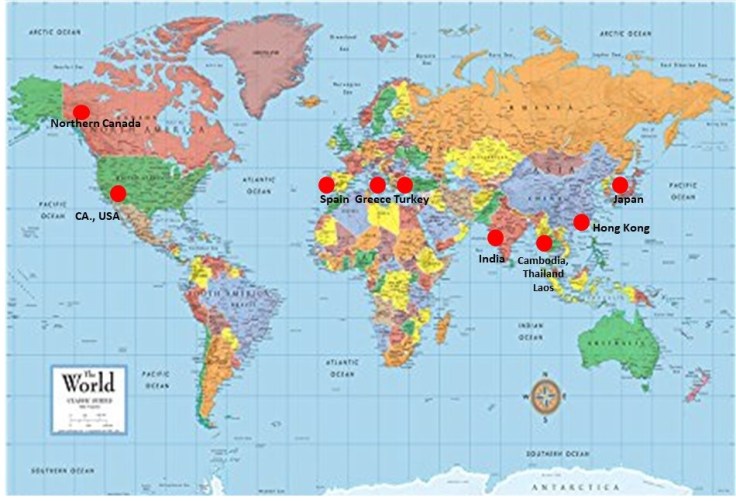
We spent three months travelling through six countries in Asia (Hong Kong, India, Thailand, Cambodia, Laos, and Japan), two months in Europe (Spain, Greece and Turkey-which is mainly in Asia), and two weeks in Northern Canada. The rest of the time we stayed in Airbnbs and with friends/family in California and the East Coast. A few weeks ago, while in Turkey, we finished one year of our nomadic life. Except for some specialized tours in some places, we did everything on our own, from selecting where to go, making arrangements and executing the plan.
What a year it has been! We stayed in more than eighty-five hotels, Airbnbs and homes of friends and family. We enjoyed hospitality of folks we had not seen in ages, further cemented our ties with family members, and experienced what so many interesting places in the world have to offer. We met hundreds of people, locals and tourists alike, and made new friendships that we hope will last a long time. We travelled by airplanes, trains, buses, taxis, long boats, huge ferries, local trains, and tuk-tuks. We also made it a point to walk to places we can in each place we stay, thereby wearing out a couple of pairs of shoes and keeping fit.
As we settle in California, we look forward to the next phase of retirement. Travel will still feature prominently in our lives, and continue to do so until we remain healthy. There are still so many places we have not been to and there are experiences to be had.
I thought it would be worthwhile summarizing the lessons we learned, and advice we can give, for travelling and enjoying different places at a slow place for extended periods. So, here are some thoughts we can share about travelling and living a “nomadic” life:
- A very important part of our travel was being in constant touch with our friends and family. We used all different types of media for doing that—WhatsApp (text, phone, video), FaceBook, Instagram, text messages, and emails. Getting away from it all may sound good, but for such an extended period, we found that keeping the communication routine we had in US was a very good idea. We also created a website/Blog for letting people know what we were doing and articulating our observations:
https://ashokboghani.wixsite.com/bogtravel
- Ashok is an avid photographer. He took lots of photographs using his trusted old Nikon D5100 and iPhone 8. He posted pictures on FaceBook on a regular basis, while being careful not to overwhelm his friends. His photo albums can be found in the website above under tab “Travel”. Here is a summary album:
https://photos.app.goo.gl/Mc5uxfZTZyiy2MaU6
- We met our communications needs using T-Mobile’s international plan that allows free data almost anywhere in the world. We could use all our Apps on the road without worrying about extra charges. For larger data dump (uploading photos), or downloads, we used hotel WiFi. Some hotels had good WiFi, some did not.
- We carried the following electronic equipment: Ashok’s laptop, Meera’s iPad, Ashok’s Kindle and our iPhones. This was a good configuration and served our needs well.
- We had to be very organized while settling in each place. All the chargers came out first to satisfy our thirsty little devices. The WiFi was activated next. Our toothbrushes and toilet kits would go to the same place. Closet and drawers would be filled with required clothes. A small day use backpack would be filled with Ashok’s camera equipment, water bottle, our dark glasses, and maps (the physical ones in case Google maps does not work—as was the case in Laos). We almost never used in room safe. Ashok was afraid of forgetting to take our stuff when we leave. Our passports used to stay in one of our suitcases. There was no fear of someone stealing it.
- We carried a substantial amount of dollar notes, including many $20 ones. This proved useful in crossing borders into Laos and Cambodia (where you need to pay in dollars) and travelling through Cambodia, where dollar is the currency. We also needed dollars in Cappadocia in Turkey, where they needed cash for hot-air balloon rides and a couple of bus tours we took. It was also our emergency stash in case the ATM machines did not work at the airport and we had to get some exchange. Interestingly, two places where we had trouble with ATMs were the most developed countries, Hong Kong and Japan. Several times the machine rejected our card with an undecipherable explanation.
- We were very careful about what we ate and drank in India. Besides that, we did not exercise that much caution. Ashok has no dietary restrictions, so he ate practically everything and had no problem, except one episode of diarrhea in Laos.
- We did everything on our own, but took organized tours in some situations where it made sense.
- Getting laundry done did not turn out to be a major problem. In most countries we found a service near our hotel that would wash/dry/fold your clothes at a very reasonable rate based on weight.
- We found that being physically fit helped a lot while travelling. Just carrying the luggage required some level of fitness. In a couple of places in Europe, we had to carry our suite cases up two flights of stairs, which would not be possible if we were not strong enough to do so. Then was our mode of exploring which required a lot of walking, in very hot weather some days and cold and rainy on some others. Of course, hiking and biking are optional activities, but participating in them added to the enjoyment of the trip.
- For Meera, being a vegetarian was a big problem in one of the Asian countries we visited…Japan. Not only were the menu items limited, most of the time they did not understand what being vegetarian is. The situation was slightly better in Europe. Meera found eating in Turkey to be a bigger challenge than in Spain or Greece. Also, in most places, we could find Indian food, so that helped give us our periodic spice fix.
What did we learn from our nomadic year?
- You don’t need a lot to live a comfortable life. For most of the year, we just had what we carried with us. It was never a problem and we did not miss a thing.
- It is possible to travel for the whole year within the same budget you have living in your comfortable suburban house. What you don’t spend on house and cars can pay for all your travels, if you do it reasonably.
- One does require mental stamina, and a voracious appetite for travel, to live nomadically for long periods. However, one saving grace—-We found that not having a home meant that we did not feel home sick.
- If you are reasonably savvy with technology, you can plan and execute a fairly complex travel plan. There are enough tools available on-line — for example: Booking.com, Airbnb.com, Ferryhopper (for ferries in Greece), Websites of every airline, Google Flights (for identifying flights), hyperdia.com (trains in Japan), and so on.
- Besides the ever present threat of pickpocketing in Europe, you can feel safe almost everywhere. In every country we walked at night, sometimes in deserted streets without feeling threatened.
- Public transportation systems are safe, efficient and not too difficult to use almost everywhere. Locals are willing to help if you run into trouble. Some of them are more up-to-date than their counterparts in US. For example, the integrated transit system in Istanbul that is fully automated, extensive and inexpensive.
- Local people are nice and helpful everywhere. Time and again, we were touched by their kindness. Unfortunately, language barriers prevented us from communicating with more people than we did.
- Tourism is reaching a breaking point. Some places are so “overtouristed”, that we don’t know how they will absorb even more folks coming to visit. For example, Angkor Wat already gets some 10,000 tourists a day. If you want to capture the temple at sunrise, you will have to fight your way through a mob lining the favorite spots. Parts of Mykonos and Santorini were so crowded that it was difficult to even walk. Remember, it was not prime tourist season when we went. Who knows what happens during the season.
 MIT Sangam Reunion